
A first-person story from Hiriketiya Bay on Sri Lanka's south coast — about being alone, learning to surf, and the quiet that comes after each wave.
1 · The Missed Bus
The first thing Hiriketiya gave me was silence.
Not the silence of Tel Aviv at 4am. That silence still has scooters, street cats and the low sound of a city drinking its coffee. This silence was wetter. Palm leaves moving above the road. A dog somewhere. The tuk-tuk driver dropped me at the top of the hill, waved once, and was gone. I stood there with a wet backpack and no plan, and for the first time in almost a year I understood how tired I really was.
I had missed the afternoon bus from Matara. Then I had missed the next one. In Colombo I had told myself that this trip would be different — slower, alone, no group chat deciding what happens next. What I had actually done was miss two buses and cry a small, quiet cry in a bakery in Dickwella town, because the woman behind the counter, without asking, cut my rice packet into smaller pieces for me like I was a child.
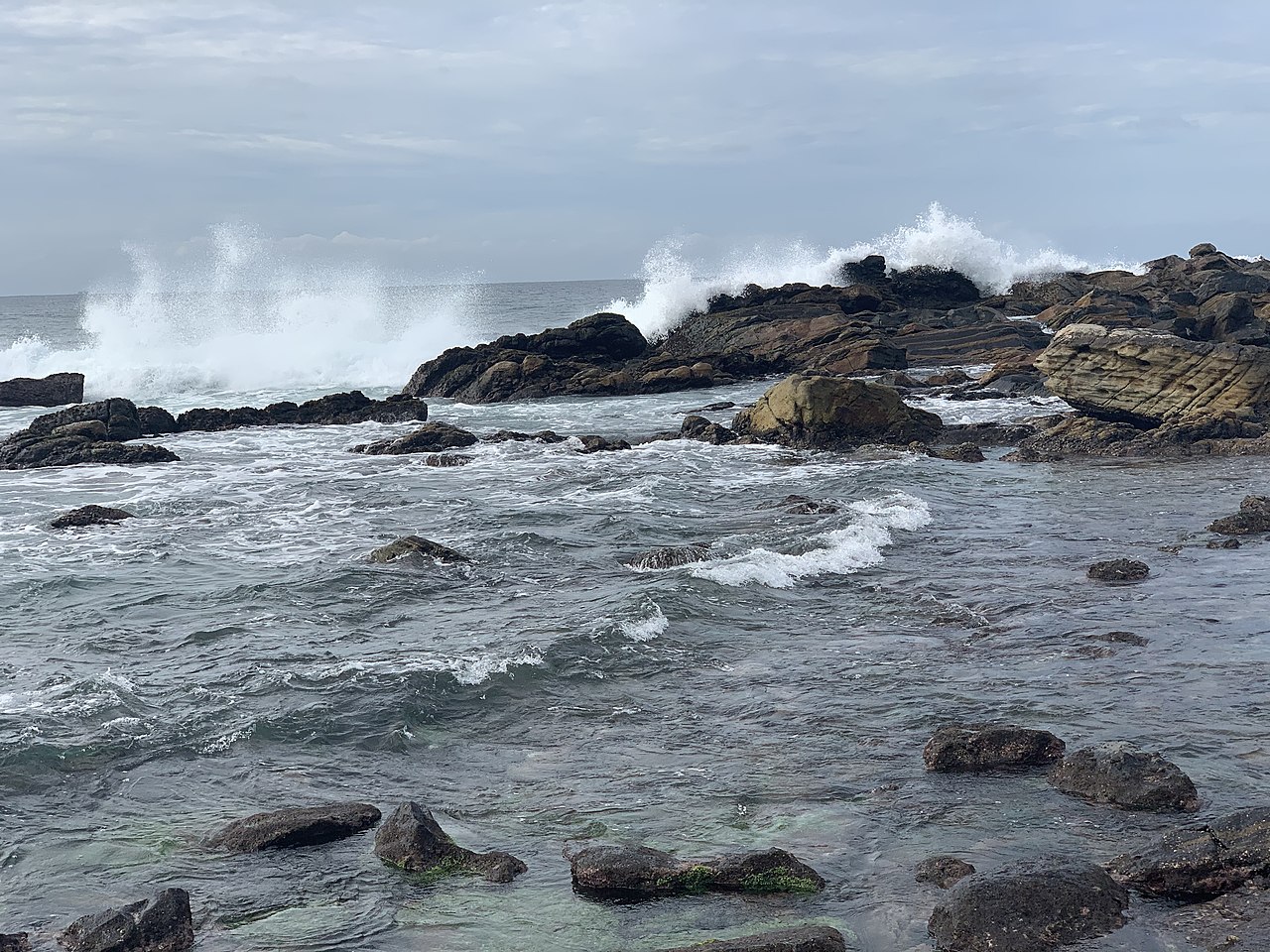
Down the hill: a horseshoe of white sand and a wave folding neatly into itself, again and again, like it was practising something.
2 · The Bay
Hiriketiya is small. Saying the name — hih-rih-KET-ih-yah — takes longer than walking from one end of the beach to the other. There is the sand, a dirt loop of small guesthouses and cafés behind it, and a jungle that leans over the water like it cannot decide if it lives here or is just visiting. There is no highway noise. In the morning, a small bread van drives around Sri Lankan villages playing a tinny version of Beethoven's Für Elise — the same tune ice-cream trucks use in other countries. There is a rooster who thinks he is a wolf.
That first afternoon I ate rice and dhal curry on a wooden bench and watched people. Surfers walking in, salty and slow. A girl painting her toenails outside a bungalow. Two Sri Lankan men playing carrom at a small table under a tree. I noticed I had not spoken since the tuk-tuk. I noticed I did not mind. And then, the way my head always does, I turned that quiet into something to be afraid of, and I opened Instagram.
I did my whole army service in a group. Then university, in a group. Then a start-up, in a group. Then a break-up, which was somehow also in a group, because we shared the same friends and the same aunt. I had never been alone in a room for more than four hours without checking who was looking for me. Hiriketiya was going to be, if nothing else, an experiment.
3 · The First Wave
My surf instructor had a scar on his shoulder in the shape of a comma. He watched me try to paddle for about two minutes and then said, 'You are pushing the water down. Don't push. Ask.'
I laughed. It came out wet.
'Ask the water,' he said again, patient. 'You are strong. Ask nicely.'
The first green wave lifted me from behind like a hand in the small of my back. I stood up, shaky, and rode maybe four seconds of clean water before falling sideways into the foam. Under the water I opened my eyes: sunlight in green stripes, my own hair floating past. I came up laughing so hard I could not breathe.
He was watching from further out, one hand on his hip, the other giving a small thumbs-up. Not big. Not loud. Just — I saw you.
I thought: this is the most someone has really seen me in a year, and he does not even know my name.

4 · The Table
The dorm at the guesthouse had six beds and, that week, five strangers. A German paramedic. A quiet Frenchman writing his master's thesis on jellyfish. Two Australian sisters who fought all day and shared everything at night. And a Sri Lankan-Canadian woman who had come back to find her father's village and had stayed nine months.
We did not become best friends. That is not the point of the story. We shared a fan and a table and the last of the mosquito coils. We asked each other's names once and mostly forgot them, and it did not matter, because at 7pm every night, without planning it, we walked down to the beach together and watched the sun burn off the day.
One evening, the Sri Lankan-Canadian woman passed me a plate of pol sambol — a spicy coconut side dish — and said, 'You look less crumpled than on Monday.'
I said, 'I feel less crumpled.'
She said, 'Hiriketiya is like that. It does not fix you. It just makes room.'
I have thought about that sentence more than any sentence a therapist has ever said to me.
5 · The Storm
On my fifth night the sky broke open. Rain came sideways under the roof. I sat on the porch in a T-shirt, watched the palm trees bend, and thought about my mother, who had emailed me twice that day and once yesterday, asking if I was safe. I thought about my ex, who had not emailed at all. I thought about the person I used to be in Tel Aviv — always laughing at the loudest table, always the one arranging the taxis home — and I could not tell if I missed her or was hiding from her.
An older man from the tea shop across the road came out with two cups without me asking, and sat down. We did not talk. We watched the rain for maybe ten minutes.
Then he said, in careful English: 'In Sinhala we have a word — nishabda. It means silence, the quiet. You know when the sea goes very still, and you can see all the way down to the sand? Like that.'
I nodded.
'Sometimes,' he said, 'we have to let one wave finish before the next one comes. Yes?'
He drank his tea. He stood up. He went back inside. The rain kept falling. I sat there and let the wave finish.

6 · The Bus Back
I stayed nine nights. I had booked three.
On the last morning I walked back into Dickwella town, to the same little bakery where I had cried on the first day. The same woman was there. She recognised me — I do not know how, I looked the same as fifty other tourists — and she smiled a big open smile and put an extra roti on the plate without asking. I paid. I said bohoma stuti — thank you very much — in the terrible accent I had been practising. She laughed and said it back to me, worse.
On the bus to Matara I sat by the window with my knees against the seat in front and watched the coast go past. I thought: I came here alone because I was afraid of being alone. I am leaving here alone because I am not afraid any more.
I had not been fixed. She was right about that. But something had made room.
I know Hiriketiya does not save anyone. It is a small bay with a nice wave and cheap tea. But it also does this quiet thing — and if you have been carrying yourself inside a group for a very long time, you may need to know it does this thing — where it gives you back to yourself, gently, one wave at a time, until you remember how to sit with the quiet after.
Book the bus. Miss it. Take the next one. The bay will still be there. So will you.
“Hiriketiya does not fix you. It just makes room.”
For the friend who has forgotten what quiet feels like.